25 studies recruiting now13 research sites across CanadaJoin the community
Medical condition

Stroke

Plain-language information about stroke in Canada, and the research enrolling for it now.
Plain-language guide, not medical advice
Reading time4 min
In CanadaAbout 108,707 strokes a year
Studies recruitingNone right now

A stroke happens when blood stops reaching part of the brain, so brain cells in that area are damaged or die. It usually arrives without warning: one side of the face droops, an arm goes weak, speech comes out slurred or jumbled. Because brain tissue is lost minute by minute, stroke is treated as an emergency from the first sign.

By the numbers in Canada
108,707strokes happen in Canada each year, which works out to roughly one stroke every five minutes.
Source: Heart & Stroke, funded research using hospital and emergency department data, 2022
WorldwideAlmost 12 million new strokes occur worldwide each year, along with more than 7 million stroke deaths, and 1 in 4 people over age 25 will have a stroke in their lifetime.Source: World Stroke Organization Global Stroke Fact Sheet, using Global Burden of Disease Study 2021 data, 2021

What a stroke is, and what it is not

A stroke is not a problem of the heart, although heart conditions can cause one. Most strokes happen when a clot blocks a blood vessel in the brain, and the rest happen when a vessel tears and bleeds into the brain. Telling those two apart changes the treatment completely, and it can only be done with brain imaging in hospital, which is why nobody can sort it out at home.

It is also not something that only happens to older people, and a warning stroke is not a false alarm. A transient ischemic attack, sometimes called a mini-stroke, is a short blockage that clears within a day, and it still needs urgent assessment because it can be followed by a larger stroke. Heart & Stroke reports that the number of younger people having strokes in Canada is rising. The FAST signs and the instruction to call 9-1-1 apply at any age.

Signs and symptoms

  • Face drooping on one side, which you can check by asking the person to smile
  • Arm weakness, so that one arm drifts down when both are raised
  • Speech that is slurred, jumbled, or hard to produce or understand
  • Sudden numbness or weakness down one side of the body
  • Sudden trouble seeing out of one or both eyes
  • Sudden dizziness, loss of balance, or a fall with no clear cause
  • A sudden severe headache with no known cause

Which signs appear depends on the part of the brain affected, so a stroke can look quite different in two people. The common thread is that symptoms begin suddenly.
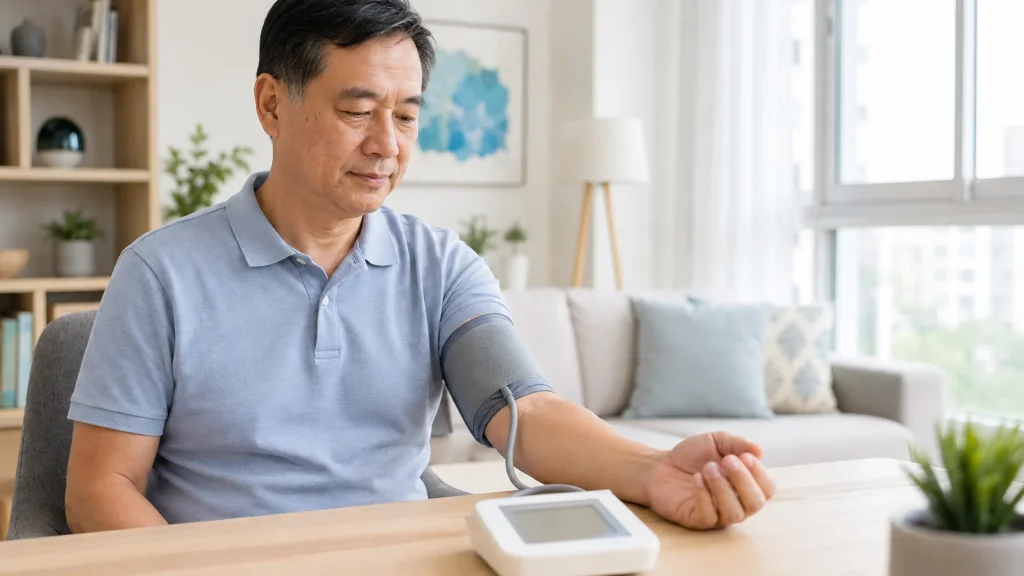
An adult sitting at home with a blood-pressure monitor on the table.
High blood pressure is the single largest contributing condition for stroke, and it is a standard part of preventing a second one. Illustrative photograph.

What raises the risk

Some risk factors cannot be changed:

  • Getting older, and a family history of stroke
  • Having already had a stroke or a transient ischemic attack
  • Ancestry, since Black, South Asian and Indigenous communities in Canada are affected more often

Others can often be worked on, usually with support from a health care team:

  • High blood pressure, which is the single largest contributing condition
  • Atrial fibrillation and other heart conditions
  • Smoking, and exposure to second-hand smoke
  • Diabetes, unhealthy cholesterol levels, and living with obesity
  • Low physical activity, and heavy alcohol use

How stroke is diagnosed in Canada

Stroke is diagnosed urgently in hospital. Emergency teams do a neurological exam and send the person straight for brain imaging, usually a CT scan and often a CT angiogram or CT perfusion study, sometimes an MRI, to tell a clot from a bleed and to see which vessel is blocked. Blood tests, an electrocardiogram and heart rhythm monitoring follow, along with an ultrasound of the neck arteries and an echocardiogram, to look for the cause. Ambulance crews in Canada take people with suspected stroke to the nearest hospital that provides urgent stroke care rather than to the closest hospital overall.

Treatment and day-to-day management

Care comes in stages: opening the blocked vessel or controlling the bleed, then preventing another stroke, then rehabilitation. Time matters for the first stage, and eligibility for those treatments is decided in hospital. Across those stages, a health care team may discuss:

  • Clot dissolving medicines given into a vein within a limited time window, known as thrombolysis
  • Endovascular thrombectomy, a procedure that removes a large clot through a catheter, offered at designated stroke centres
  • Neurosurgical and critical care management for bleeding strokes, including blood pressure control and reversal of anticoagulants
  • Medicines to prevent another stroke, including antiplatelets, anticoagulants for atrial fibrillation, blood pressure lowering drugs and statins, plus carotid surgery or stenting for selected people
  • Inpatient and community rehabilitation, including physiotherapy, occupational therapy, speech-language pathology, and support for mood, memory and return to work

Recovery paths differ widely, and so do the services available in each region. What happens next is worked out between you, your family and your own care team, and nothing on this page is a recommendation about any specific treatment.

When to talk to a doctor

  • Call 911 immediately for any FAST sign: Face drooping, Arm weakness, Speech difficulty, Time to call 9-1-1. Do not drive to hospital, because an ambulance will take you to a hospital that provides urgent stroke care.
  • Call 911 even if the symptoms go away within minutes. A transient ischemic attack is a warning that needs urgent assessment.
  • Call 911 for a sudden severe headache unlike any you have had before, or for sudden loss of vision, balance or consciousness.

Why clinical research matters for stroke

Many people arrive too late for the time-limited treatments, large numbers are left with lasting disability, and there is still no established treatment that repairs brain tissue after the event. Studies now recruiting are testing wider time windows and imaging-based selection for thrombolysis and thrombectomy, newer clot dissolving agents such as tenecteplase, and factor XI inhibitors for stroke prevention. Others are studying treatments for bleeding strokes, cell and drug therapies aimed at recovery, brain stimulation and robot-assisted rehabilitation, telestroke and prehospital care models for rural and remote Canada, and the detection of silent atrial fibrillation after a stroke of unknown cause.

Those questions are answered in clinical studies, including studies in rehabilitation and recovery that run months after the event. Taking part is voluntary, you or a substitute decision maker give informed consent before anything begins, and you can withdraw at any time without affecting the care you get from your own team. No one can say in advance whether a study will help you personally.

Learn more from Canadian sources

Where this information comes from (5 sources)
  1. Heart & Stroke, Stroke in Canada is on the rise (research using 2017 to 2018 hospital and emergency department data), 2022
  2. Public Health Agency of Canada, Heart disease: Monitoring (Canadian Chronic Disease Surveillance System, 2023 to 2024), 2024
  3. Statistics Canada, Top 10 leading causes of death, Canada, 2023, 2023
  4. Public Health Agency of Canada, Stroke, 2026
  5. World Stroke Organization Global Stroke Fact Sheet 2025, International Journal of Stroke, 2025

This page is written in plain language for people considering clinical research. It is general health information, not medical advice, and it does not replace a conversation with your own doctor or nurse practitioner.

Common questions

What does FAST stand for?

Face, Arms, Speech, Time. Check whether the face is drooping, whether the person can raise both arms, and whether speech is slurred or jumbled, then call 9-1-1 right away if any of these are present. Heart & Stroke uses this wording across Canada, and it helps to note the time symptoms began, because treatment decisions depend on it.

Can younger people have a stroke?

Yes. Heart & Stroke reports that the number of younger people having strokes in Canada is rising, alongside the overall increase driven by an ageing population. The FAST signs and the instruction to call 9-1-1 apply at any age.

How much recovery is possible after a stroke?

Recovery varies widely and depends on the part of the brain affected, how quickly treatment was given, and access to rehabilitation. Canadian data show that more than half of stroke survivors report fair or poor health and about half report limits on mobility, and Canadian Stroke Best Practices set out what rehabilitation services should be offered.
What to do next
  1. Talk to your doctor. This guide is information, not medical advice.
  2. Check for a match. Find your study match
  3. Not ready yet? Join the community and we will write to you when something opens.
Clinical research
The JoinAStudy community
Studies for Stroke open regularly — join the JoinAStudy community and we'll contact you when one may fit.
Join the community →

Learn more about Stroke

Health blog →

Connecting Canadians with clinical research studies conducted by a network of physicians committed to advancing medicine — since 1995.

JoinAStudy.ca provides information about clinical research and does not provide medical advice, diagnosis, or treatment. Only a qualified study doctor can determine your eligibility for a study. Participation is always voluntary.

© 2026 JoinAStudy.ca · A network of Canadian physicians.|Designed by Pixelore.ca