
25 studies recruiting now13 research sites across CanadaJoin the community
Home/Conditions/Crohn’s Disease
Medical condition

Crohn’s Disease

Plain-language information about Crohn's disease in Canada, and the research enrolling for it now.
Plain-language guide, not medical advice
Reading time3 min
In Canada410 per 100,000; 322,600 have IBD
Studies recruitingNone right now

Crohn’s disease is a lifelong inflammatory bowel disease. Inflammation and ulceration develop in the digestive tract, most often in the lower small bowel and upper colon. Day to day that can mean cramping pain, persistent diarrhoea, tiredness and weight loss.

By the numbers in Canada
410 per 100,000people in Canada were living with Crohn's disease in 2023. Counting Crohn's disease and ulcerative colitis together, 322,600 people live with inflammatory bowel disease, about 1 in 122.
Source: Crohn's and Colitis Canada, 2023 Impact of Inflammatory Bowel Disease in Canada, 2023
  • New diagnoses are frequent and rising. The 2023 report puts the incidence of Crohn's disease at 12.2 per 100,000 people a year, with over 11,700 Canadians newly diagnosed with inflammatory bowel disease in 2023, and forecasts 470,000 Canadians living with it by 2035. Prevalence already ranges from 720 per 100,000 in Manitoba to 968 per 100,000 in Alberta. Source: Crohn's and Colitis Canada, 2023 Impact of IBD in Canada, 2023
  • Canada is described as having among the highest burdens of inflammatory bowel disease in the world, and among the highest rates in children. Paediatric onset incidence is rising by an average of 1.23 percent year over year while adult onset is stable, and Crohn's and Colitis Canada reports that Crohn's incidence in children under 10 has doubled since 1995. Source: Crohn's and Colitis Canada, 2023 Impact of IBD in Canada, Executive Summary, 2023
  • The cost has roughly doubled in five years. Inflammatory bowel disease cost Canada an estimated $5.38 billion in 2023, made up of $3.33 billion in direct health care costs and $2.05 billion in indirect and out-of-pocket costs, compared with $2.6 billion in 2018. Source: Crohn's and Colitis Canada, 2023 Impact of IBD in Canada, 2023
Worldwide3.8 million people worldwide were living with inflammatory bowel disease in 2021 according to the Global Burden of Disease study, an age standardised rate of 44.9 per 100,000. Canada's rate of 825 per 100,000 sits far above that global average.Source: Global Burden of Disease Study 2021, Gastroenterology Report, 2025

What Crohn’s disease is, and what it is not

Crohn’s is one of two main forms of inflammatory bowel disease. Crohn’s and Colitis Canada describes it as able to strike anywhere from mouth to anus, in patches, with healthy bowel between. Ulcerative colitis differs: one continuous stretch in the colon and rectum, involving only the inner lining.

It is also not caused by anything you ate or did. The cause is not known, and Crohn’s and Colitis Canada points to genetics, environment and the gut microbiome. Food affects how you feel day to day, but it did not start the disease.

Signs and symptoms

  • Cramping abdominal pain, often low on the right side
  • Diarrhoea lasting weeks, sometimes with sudden urgency
  • Blood in the stool
  • Weight loss, low appetite and persistent tiredness
  • Fever during a flare, and mouth ulcers
  • Aching joints, sore eyes or skin sores, since inflammation can appear outside the bowel

Crohn’s runs in flares and quieter stretches, and no two people are the same.

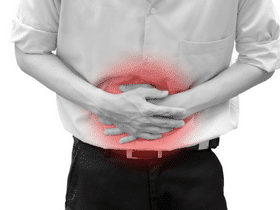
An adult standing at home holding a glass of water.
Crohn's disease usually runs in flares and quieter stretches. Illustrative photograph.

What raises the risk

Some risk factors cannot be changed:

  • A family history of Crohn’s disease or ulcerative colitis
  • Age, since most people are diagnosed before 30
  • Living in Canada, which the 2023 national report ranks among the highest burdens in the world

Others can often be worked on, usually with support from a health care team:

  • Changes in the gut microbiome, named alongside genetics and environment
  • Environmental exposures, listed while the exact cause remains unknown
  • Regular contact with a gastroenterology team, since untreated inflammation leads to narrowed bowel, fistulas and abscesses

How Crohn’s disease is diagnosed in Canada

There is no single test. A family doctor usually starts with your history, an examination, and blood and stool tests. The Canadian Digestive Health Foundation describes the faecal calprotectin stool test as a way to see whether there is inflammation in the bowel, which helps separate inflammatory bowel disease from irritable bowel syndrome. A gastroenterologist then confirms it with endoscopy and biopsies, usually a colonoscopy reaching the end of the small bowel, plus imaging for the parts an endoscope cannot reach.

Treatment and day-to-day management

There is no cure, so care aims to settle inflammation and prevent complications. A gastroenterology team may discuss:

  • Aminosalicylates, also written as 5-ASA, and corticosteroids to settle a flare
  • Immunomodulator medicines taken longer term to keep inflammation down
  • Biologic medicines and biosimilars, given by injection or infusion, grouped by Crohn’s and Colitis Canada as biotherapies
  • Newer oral small molecule medicines, including JAK inhibitors and S1P receptor modulators
  • Exclusive enteral nutrition, a liquid diet used mainly in children, and antibiotics in some cases
  • Surgery when medicines are not enough or a complication develops, sometimes including an ostomy

No two cases are alike. These are decisions for you and your own gastroenterology team.

When to talk to a doctor

  • Severe abdominal pain with vomiting, a swollen abdomen and no bowel movements can mean a blockage. Go to an emergency department, and call 911 if the pain is severe or you cannot keep fluids down.
  • Heavy bleeding from the rectum, or feeling faint or short of breath with bleeding, needs emergency assessment.
  • Fever with worsening abdominal pain, or a tender lump near the anus, needs same day assessment.
  • Diarrhoea lasting more than a few weeks, blood in the stool, or unexplained weight loss should be assessed.

Why clinical research matters for Crohn’s disease

There is no cure, and many people either never respond well to a given medicine or lose their response over time. The 2023 national report shows inflammatory bowel disease in children rising year after year while adult onset stays flat, and no one can yet explain that, or why Canadian rates are among the highest in the world. Studies are testing new biologic and small molecule targets, diet and microbiome approaches, intestinal ultrasound for monitoring, and ways to predict who will need surgery.

Taking part is voluntary. You give informed consent first, you can stop at any time without affecting your regular care, and no one can say in advance whether a study will help you personally.

Learn more from Canadian sources

Where this information comes from (6 sources)
  1. Crohn's and Colitis Canada, 2023 Impact of Inflammatory Bowel Disease in Canada: epidemiology, 2023
  2. Crohn's and Colitis Canada, 2023 Impact of IBD in Canada: executive summary, 2023
  3. Crohn's and Colitis Canada, what are Crohn's and colitis, 2026
  4. Crohn's and Colitis Canada, treatment and medications, 2026
  5. Canadian Digestive Health Foundation, IBD: Crohn's disease, 2025
  6. Global Burden of Disease Study 2021, inflammatory bowel disease, Gastroenterology Report, 2025

This page is written in plain language for people considering clinical research. It is general health information, not medical advice, and it does not replace a conversation with your own doctor or nurse practitioner.

Common questions

How is Crohn's disease different from ulcerative colitis?

Both are forms of inflammatory bowel disease. Crohn's and Colitis Canada describes Crohn's as able to affect anywhere from the mouth to the anus, in patches, with healthy bowel in between, and as going deeper into the wall of the bowel. Ulcerative colitis is more localised: it affects the colon including the rectum, in one continuous stretch, and involves only the inner lining. Bleeding and urgency are more common in colitis, and mouth ulcers are more common in Crohn's. Narrowed bowel, fistulas and abscesses are complications specific to Crohn's.

Did something I ate or did cause this?

No. The cause of Crohn's disease is not known. Crohn's and Colitis Canada points to a combination of genetics, environmental factors and changes in the gut microbiome. Food can affect how you feel day to day, and a dietitian can help you work out what suits you, but diet did not cause the disease. Neither did stress.

Why would someone with Crohn's disease join a clinical trial?

Because many people either never respond well to a given medicine or lose their response over time, and trials are how new options and better ways of using existing ones get tested. Taking part usually means extra assessments and close monitoring by a research team. Participation is voluntary, you give informed consent before anything begins, and you can withdraw at any time without affecting the care you get from your own gastroenterology team.

What to do next
  1. Talk to your doctor. This guide is information, not medical advice.
  2. Check for a match. Find your study match
  3. Not ready yet? Join the community and we will write to you when something opens.
Clinical research
The JoinAStudy community
Studies for Crohn’s Disease open regularly — join the JoinAStudy community and we'll contact you when one may fit.
Join the community →

Learn more about Crohn’s Disease

Health blog →

Connecting Canadians with clinical research studies conducted by a network of physicians committed to advancing medicine — since 1995.

JoinAStudy.ca provides information about clinical research and does not provide medical advice, diagnosis, or treatment. Only a qualified study doctor can determine your eligibility for a study. Participation is always voluntary.

© 2026 JoinAStudy.ca · A network of Canadian physicians.|Designed by Pixelore.ca