25 studies recruiting now13 research sites across CanadaJoin the community
Home/Conditions/Dementia
Medical condition

Dementia

Plain-language information about dementia in Canada, for the person living with it and for the people caring.
Plain-language guide, not medical advice
Reading time6 min
In Canada771,939 people, 414 more a day
Studies recruiting1 now enrolling

Dementia is not one disease. It is the word for a group of symptoms, memory loss, trouble with thinking, language or problem solving, and changes in mood or behaviour, caused by disorders affecting the brain and severe enough to interfere with everyday life. Alzheimer’s disease is the most common cause, and a separate page on this site covers it in detail.

By the numbers in Canada
771,939people in Canada were living with dementia as of January 1, 2025, according to the Alzheimer Society of Canada. More than 414 people develop dementia every day, which is more than 17 an hour.
Source: Alzheimer Society of Canada, Dementia numbers in Canada, 2025
  • The numbers are rising. The Alzheimer Society of Canada projects nearly 1 million people living with dementia in Canada by 2030, and more than 1.7 million by 2050, when an estimated 685 people a day would be diagnosed. Source: Alzheimer Society of Canada, Landmark Study, 2025
  • Dementia affects women more than men and climbs steeply with age. In 2020 an estimated 61.8% of people living with dementia in Canada were female, and prevalence more than doubles every five years after 65, from under 1% at ages 65 to 69 to about 1 in 4 at 85 and older. The rate of new cases has been falling: 1,507 per 100,000 Canadians aged 65 and older in 2012 to 2013, against 1,411 per 100,000 in 2022 to 2023. Source: Canadian Institute for Health Information and Public Health Agency of Canada, 2025
  • Care partners carry much of the load. Family and friends provide more than 580 million hours of care a year in Canada, averaging 26 hours a week. Among people caring at home for someone with dementia, reported caregiver distress fell from 37.1% in 2019 to 2020 to 35.3% in 2023 to 2024, still roughly double the 19.2% recorded for caregivers of people with other conditions. Source: Public Health Agency of Canada, A dementia strategy for Canada, 2025 annual report, 2025
Worldwide57 million people worldwide were living with dementia in 2021, with nearly 10 million new cases every year. Alzheimer's disease is the most common form and may account for 60% to 70% of cases.Source: World Health Organization, 2021

What dementia is, and what it is not

The Alzheimer Society of Canada describes dementia as an overall term for a set of symptoms caused by disorders affecting the brain. Alzheimer’s disease accounts for the largest share: the World Health Organization says it may be behind 60% to 70% of cases. Vascular dementia is the second most common, and there are others, including Lewy body dementia, frontotemporal dementia, and mixed dementia where more than one process is at work. Their symptoms overlap, which is part of why telling them apart takes time.

Dementia is also not a normal part of getting older. The Alzheimer Society notes that close to 40% of people over 65 have some age-associated memory change, and that is something different. It is not only a condition of later life either: people in their 40s and 50s can develop young onset dementia. And there is no set timeline. How dementia unfolds depends on the cause, on other health conditions, and on the support around a person, so two people with the same diagnosis can have very different years ahead.

Signs and symptoms

  • Forgetting recent conversations, appointments or events more often than before
  • Repeating the same questions or stories within a short time
  • Trouble finding words, following a conversation, or keeping the thread of a story
  • Confusion about the date, the season, or where you are
  • Difficulty with familiar tasks such as managing money, following a recipe or driving a known route
  • Putting things in unusual places and not being able to retrace steps to find them
  • Changes in mood, personality, judgement or motivation, often noticed first by people close by

Which symptoms come first depends on the cause. Memory is often affected earliest in Alzheimer’s disease, while other causes begin with changes in personality, language, movement or alertness. Symptoms can vary from day to day, and family often notice a change first.

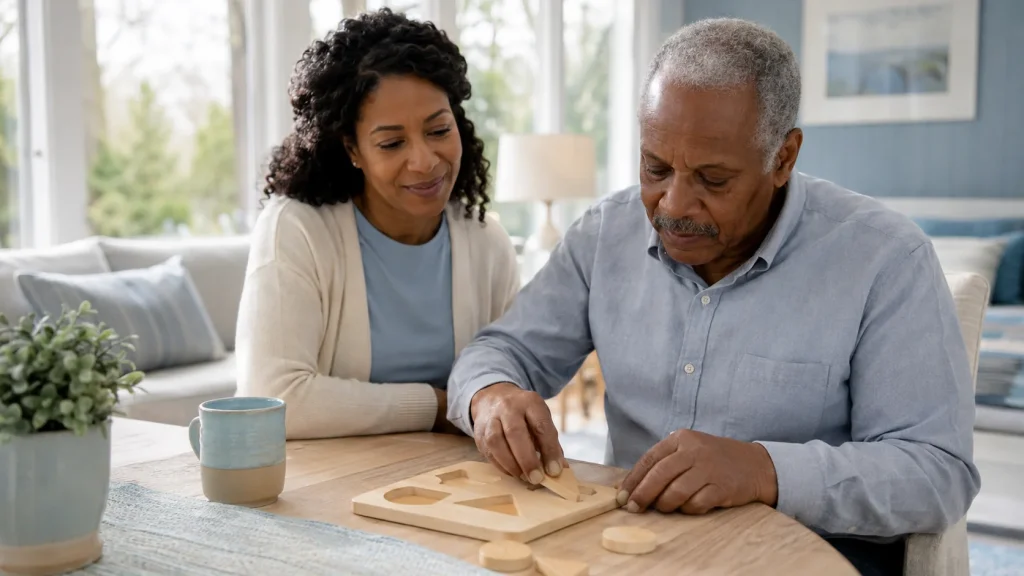
An older adult's hands resting together on a table in soft light.
Canadian dementia care is built around the person and the care partner together, and includes social contact, physical activity and routines that make daily tasks easier. Illustrative photograph.

What raises the risk

Some risk factors cannot be changed:

  • Getting older, since prevalence more than doubles every five years after 65
  • Being female: an estimated 61.8% of people living with dementia in Canada in 2020 were women
  • Family history and certain genetic factors

Others can often be worked on, usually with support from a health care team. The 2024 Lancet Commission on dementia, cited in Canada’s 2025 dementia strategy report, identified 14 modifiable risk factors together linked to close to 45% of dementia cases worldwide:

  • Blood vessel and metabolic health, including high blood pressure, diabetes, high LDL cholesterol, extra body weight and smoking
  • Untreated hearing loss and untreated vision loss
  • Physical inactivity, heavy alcohol use, social isolation, depression and lower education
  • Head injury, including from falls, and exposure to air pollution

How dementia is diagnosed in Canada

Assessment usually starts with a family doctor or nurse practitioner, who takes a history from you and, with your permission, from someone who sees you regularly, and asks how the changes affect daily tasks. Short thinking and memory tests such as the MoCA or the MMSE are commonly used, along with blood tests and a medication review to look for causes that can be treated in their own right, including thyroid problems, vitamin deficiency, infection, depression and medication side effects. Brain imaging may be ordered. Many people are then referred to a geriatrician, neurologist, geriatric psychiatrist or a memory clinic. Since Health Canada authorised the first medicines aimed at amyloid in Alzheimer’s disease, some assessments now also involve an amyloid PET scan or spinal fluid test plus genetic testing. The Alzheimer Society of Canada notes that access to those specialists, tests and infusions varies a great deal across the country.

Treatment and day-to-day management

Clinical research for Dementia is enrolling. See the current studies

Care in Canada is built around two people: the person living with dementia and the care partner. It combines treating other health conditions, medicines where they apply, practical support at home, and planning ahead. Depending on the cause and the stage, a health care team may discuss:

  • Assessment and management of contributing and treatable conditions, from blood pressure and diabetes to thyroid problems, hearing, vision, depression, sleep and medication side effects
  • Medicines long used in Alzheimer’s disease and related dementias, including cholinesterase inhibitors and memantine
  • Amyloid-targeting medicines for early Alzheimer’s disease specifically. Health Canada authorised lecanemab on 25 October 2025 and donanemab on 1 May 2026, both for mild cognitive impairment or mild dementia due to Alzheimer’s disease, with requirements including confirmed amyloid and ApoE genetic status. The Alzheimer Society of Canada states these slow progression rather than reverse it, and that coverage depends on your province or territory
  • Non-drug approaches, including cognitive stimulation and rehabilitation, structured physical activity, social contact, sleep support, and routines that make daily tasks easier
  • Support for the household: occupational therapy and home safety assessment, driving assessment, speech language therapy, home care, respite, advance care planning, and the Alzheimer Society’s First Link referral programme

No two households look the same. These are decisions for you, the person you care for, and your own clinicians, and this page is not a recommendation about any of them.

When to talk to a doctor

  • Call 911 right away for sudden confusion or sudden memory loss, especially with weakness or numbness on one side, a drooping face, trouble speaking, or a change in vision. These can be signs of a stroke, and time matters.
  • Seek urgent care for confusion that comes on over hours or a few days, particularly alongside fever, a fall or head injury, a new medicine, or a sudden change in behaviour, since delirium and its causes need prompt assessment.
  • Book an appointment with your health care provider if memory or thinking changes are getting worse over months, are being noticed by people close to you, or are starting to affect driving, finances, medicines or safety at home. Care partners can raise concerns too, and can ask about support for themselves at the same appointment.

Why clinical research matters for dementia

Nothing available today stops or reverses dementia. The first medicines aimed at the underlying disease apply only to early Alzheimer’s disease, only to some people who have it, and only where the necessary tests and monitoring are available. Diagnosis also often comes late, and separating one cause of dementia from another remains difficult. There is real progress to build on: the rate of new cases among Canadians aged 65 and older fell from 1,507 per 100,000 in 2012 to 2013 to 1,411 in 2022 to 2023, and 14 risk factors are now linked to close to 45% of cases worldwide. Studies are currently looking at blood-based and imaging markers that could detect disease earlier and separate the causes, disease-modifying treatments for Alzheimer’s disease and for other causes, treatments for symptoms such as agitation and disturbed sleep, risk-reduction programmes combining exercise, diet, cognitive training, hearing care and blood pressure control, and better support for care partners at home.

Most dementia studies ask you to bring a study partner, a family member or friend who sees you regularly, because changes in thinking are often clearer to them. Taking part is voluntary, both of you give informed consent first, and either of you can stop at any time without affecting the care you get from your own doctor. No one can tell in advance whether a study will help you personally.

Learn more from Canadian sources

Where this information comes from (7 sources)
  1. Alzheimer Society of Canada, Dementia numbers in Canada (Landmark Study), 2025
  2. Alzheimer Society of Canada, What is dementia, 2026
  3. Public Health Agency of Canada, A dementia strategy for Canada: Together we achieve, 2025 annual report, 2025
  4. Canadian Institute for Health Information, How dementia impacts Canadians, 2024
  5. Alzheimer Society of Canada, Health Canada approves lecanemab, 2025
  6. Alzheimer Society of Canada, Health Canada approves donanemab, 2026
  7. World Health Organization, Dementia fact sheet, 2021

This page is written in plain language for people considering clinical research. It is general health information, not medical advice, and it does not replace a conversation with your own doctor or nurse practitioner.

Common questions

Is dementia the same thing as Alzheimer's disease?

No. Dementia is the overall term for a set of symptoms caused by disorders affecting the brain. Alzheimer's disease is the most common cause of those symptoms, and the World Health Organization says it may account for 60% to 70% of cases. Other causes include vascular dementia, which is the second most common, Lewy body dementia, frontotemporal dementia, and mixed dementia where more than one process is at work. The distinction matters because the causes differ in how they usually begin, what tends to be affected first, and which treatments apply. A separate page on this site covers Alzheimer's disease.

Can anything be done about the risk of dementia?

Some risk factors cannot be changed, including age, family history and genetics. Others can often be worked on with support from a health care team. The 2024 Lancet Commission on dementia, cited in Canada's 2025 dementia strategy report, identified 14 modifiable risk factors together linked to close to 45% of dementia cases worldwide, among them blood pressure, diabetes, cholesterol, smoking, heavy alcohol use, physical inactivity, social isolation, depression, head injury, air pollution, and untreated hearing and vision loss. What that means for one person is a conversation for them and their own clinician.

Why do dementia studies ask for a study partner?

Most dementia and memory studies ask you to bring a family member or friend who sees you regularly, because changes in thinking and memory are often clearer to someone close to you than to the person experiencing them. That person may complete questionnaires and attend some visits. Both of you give informed consent, and either of you can stop taking part at any time without affecting the care you get from your own doctor.

What to do next
  1. Talk to your doctor. This guide is information, not medical advice.
  2. See the current studies. 1 study for Dementia
  3. Not ready yet? Join the community and we will write to you when something opens.
Research studies

Studies for Dementia

See all Dementia trials →

Learn more about Dementia

Health blog →

Connecting Canadians with clinical research studies conducted by a network of physicians committed to advancing medicine — since 1995.

JoinAStudy.ca provides information about clinical research and does not provide medical advice, diagnosis, or treatment. Only a qualified study doctor can determine your eligibility for a study. Participation is always voluntary.

© 2026 JoinAStudy.ca · A network of Canadian physicians.|Designed by Pixelore.ca