25 studies recruiting now13 research sites across CanadaJoin the community
Home/Conditions/Memory loss (amnesia)
Medical condition

Memory loss (amnesia)

Plain-language information about memory loss, mild cognitive impairment and dementia in Canada, and the research enrolling now.
Plain-language guide, not medical advice
Reading time5 min
In Canada771,939 living with dementia
Studies recruiting5 now enrolling

Some forgetfulness comes with getting older, such as taking longer to land on a name you know perfectly well. Other changes are worth having looked at: ones that keep getting worse, that people close to you notice, or that start to affect everyday tasks. This page covers that whole range, from normal memory changes through mild cognitive impairment to dementia.

By the numbers in Canada
771,939people in Canada were living with dementia as of January 1, 2025, according to the Alzheimer Society of Canada, which estimates that 414 people develop dementia every day.
Source: Alzheimer Society of Canada, Dementia numbers in Canada, 2025
  • The numbers are rising quickly. The Alzheimer Society of Canada projects nearly 1 million people living with dementia in Canada by 2030 and more than 1.7 million by 2050, when an estimated 685 people would be diagnosed every day. Source: Alzheimer Society of Canada, Landmark Study, 2025
  • Dementia in Canada affects women more than men and rises steeply with age. In 2020, 61.8% of people living with dementia in Canada were women, and prevalence more than doubles every five years after 65, from under 1% at ages 65 to 69 to about 1 in 4 among people aged 85 and older. Source: Alzheimer Society of Canada and Canadian Institute for Health Information, 2024
  • Care costs and caregiving hours are substantial. Total health system and out-of-pocket costs of caring for people with dementia are 5.5 times greater than for people without dementia, with projected annual costs rising from 8.3 billion dollars to 16.6 billion dollars by 2031. Family and friends provide more than 580 million hours of care a year, averaging 26 hours a week compared with 17 hours for other health conditions. Source: Canadian Institute for Health Information and Alzheimer Society of Canada, 2024
Worldwide57 million people worldwide were living with dementia in 2021, with nearly 10 million new cases each year. Dementia is the seventh leading cause of death globally, and its economic cost reached about 1.3 trillion US dollars in 2019.Source: World Health Organization, 2021

Normal memory changes, mild cognitive impairment and dementia

These are three different things, and the distinction matters. Normal aging tends to mean slower recall: the name or the word arrives, just later, and more slowly when you are tired or distracted. Mild cognitive impairment, often shortened to MCI, means problems with memory, language, thinking or judgement that are greater than expected for your age but not severe enough to stop you living independently. Dementia is when those changes become significant enough to interfere with everyday life, and Alzheimer’s disease is its most common cause. Amnesia refers to a more specific loss of memories, which can follow a head injury, a stroke, an infection or certain medical conditions.

Mild cognitive impairment is not a diagnosis of early dementia, and it is not a one-way road. The Alzheimer Society of Canada states that outcomes vary: some people remain stable, some improve, and not everyone goes on to develop dementia. Some causes of memory trouble can also be treated once they are identified, including thyroid problems, vitamin deficiency, infection, depression and side effects of medicines. That is exactly why assessment begins by looking for them, and why getting checked is worth doing rather than worth dreading. Related conditions are covered on our pages for Alzheimer’s disease and dementia.

Signs and symptoms

  • Forgetting recent conversations, appointments or events more often than before
  • Repeating the same questions or stories within a short time
  • Trouble finding the right word, or losing the thread in conversation
  • Getting confused about the date, the season or where you are
  • Difficulty with familiar tasks such as managing money, following a recipe or driving a known route
  • Misplacing items and putting them in unusual places
  • Changes in mood, personality, judgement or motivation noticed by family or friends

These changes usually come on gradually over months rather than suddenly. What matters most is not any single lapse but whether things have changed from how you used to be, and whether daily life is affected.

An older adult's hands resting together on a table in soft light.
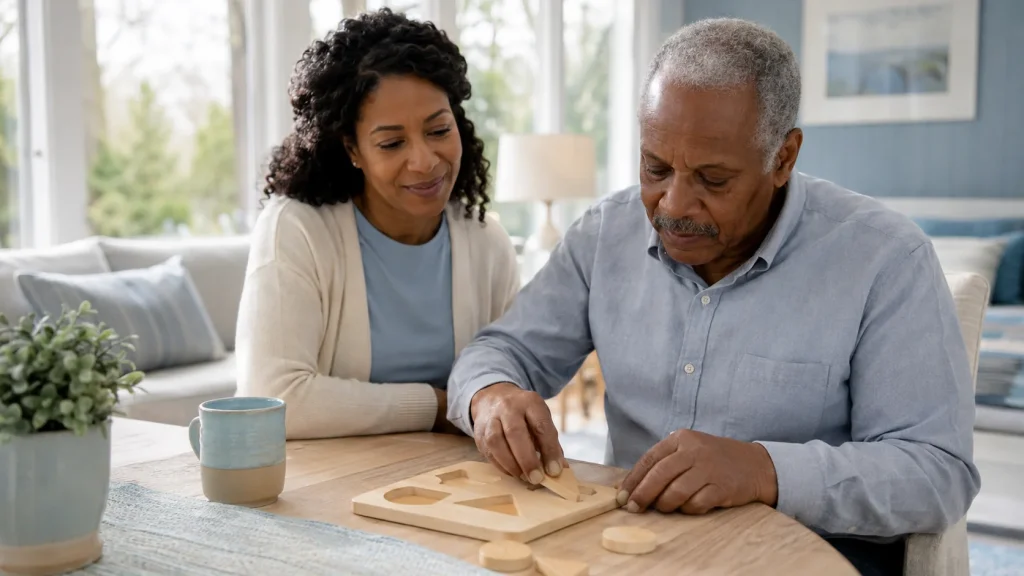
Structured physical activity, social engagement and routines that make daily tasks easier are part of care in Canada, alongside treating conditions that affect thinking. Illustrative photograph.

What raises the risk

Some risk factors cannot be changed:

  • Getting older, since risk roughly doubles every five years after age 65
  • Being female, since women make up about 62% of people living with dementia in Canada
  • Family history and certain genetic factors
  • Down syndrome and some other genetic conditions

Others can often be worked on, usually with support from a health care team:

  • High blood pressure, diabetes, high cholesterol, carrying extra body weight and smoking, which affect the blood vessels supplying the brain
  • Physical inactivity, heavy alcohol use, social isolation, depression and poor sleep
  • Untreated hearing loss, and repeated head injuries including those from falls

How memory problems are assessed in Canada

Assessment usually starts with a family doctor or nurse practitioner, who takes a history from you and, with your permission, from someone close to you, and asks how the changes affect daily tasks. Short thinking and memory tests such as the MoCA or the MMSE are commonly used, along with blood tests and a review of your medicines to look for reversible contributors such as thyroid problems, vitamin deficiency, infection, depression or medication side effects. Brain imaging may be ordered, and people are often referred to a geriatrician, neurologist, geriatric psychiatrist or a memory clinic. The Alzheimer Society of Canada notes there is no single test for mild cognitive impairment, so the assessment rests on the overall picture over time.

Treatment and day-to-day management

Clinical research for Memory loss (amnesia) is enrolling. See the current studies

Care covers more than medicines. It is usually built around treating what can be treated, keeping daily life workable, and supporting the people around you as well as you. Depending on the findings and what matters to you, a health care team may discuss:

  • Assessment and management of contributing conditions, including blood pressure, diabetes, cholesterol, thyroid problems, vitamin deficiencies, hearing loss, depression and side effects of medicines
  • Medicines used in Alzheimer’s disease and related dementias, including cholinesterase inhibitors and memantine, and newer amyloid-targeting therapies whose availability in Canada depends on Health Canada authorisation and provincial funding decisions
  • Non-drug approaches such as cognitive stimulation and rehabilitation, structured physical activity, social engagement, sleep support, and routines that make daily tasks easier
  • Occupational therapy, home safety assessment, driving assessment, and speech language therapy where communication is affected
  • Caregiver support, respite, home care and advance care planning, coordinated through provincial home and community care programs and Alzheimer Society chapters

What fits depends on the cause, the stage and your own priorities, including how you want decisions handled in future. Those are conversations for you, the people you choose to involve, and your own clinician.

When to talk to a doctor

  • Call 911 immediately for sudden confusion or sudden memory loss, especially with weakness or numbness on one side, a drooping face, trouble speaking, or vision changes. These are signs of a possible stroke, and time matters.
  • Seek urgent care for confusion that comes on over hours or a few days, particularly with fever, a fall or head injury, a new medicine, or a sudden change in behaviour, since delirium and its causes need prompt assessment.
  • Book an appointment with your health care provider if memory or thinking changes are getting worse over months, are noticed by people close to you, or are starting to affect driving, finances, medicines or safety at home.

Why clinical research matters for memory loss and dementia

Nothing available today stops or reverses Alzheimer’s disease or most other dementias, and clinicians cannot reliably say which people with mild cognitive impairment will progress, stay stable, or improve. Diagnosis also often comes late, after substantial change has already happened. Research is concentrated on blood-based and imaging biomarkers that could detect disease earlier, disease-modifying drugs including amyloid and tau-targeting and anti-inflammatory approaches, treatments for symptoms such as agitation and sleep disturbance, and prevention trials that combine exercise, diet, cognitive training and management of blood pressure, hearing and other risk factors.

Many studies in this area ask you to bring a study partner, a family member or friend who sees you regularly, because changes in thinking are often clearer to someone else than to the person living with them. Taking part is voluntary, you and your study partner both give informed consent before anything begins, and either of you can stop at any time without affecting the care you get from your own doctor. No one can say in advance whether a study will help you personally.

Learn more from Canadian sources

Where this information comes from (6 sources)
  1. Alzheimer Society of Canada, Dementia numbers in Canada (Landmark Study), 2025
  2. Alzheimer Society of Canada, The Landmark Study: The Many Faces of Dementia in Canada, 2024
  3. Canadian Institute for Health Information, How dementia impacts Canadians, 2024
  4. Public Health Agency of Canada, Dementia in Canada, including Alzheimer's disease: Highlights from the Canadian Chronic Disease Surveillance System, 2017
  5. Alzheimer Society of Canada, Mild cognitive impairment, 2026
  6. World Health Organization, Dementia fact sheet, 2021

This page is written in plain language for people considering clinical research. It is general health information, not medical advice, and it does not replace a conversation with your own doctor or nurse practitioner.

Common questions

Is forgetting names a sign of dementia?

On its own, usually not. Taking longer to recall a name or word is a common part of normal aging, especially when you are tired or distracted. The changes that need assessment are ones that are getting worse over time, that other people notice, or that start to affect everyday tasks such as managing money, taking medicines or driving safely.

Does mild cognitive impairment always turn into dementia?

No. The Alzheimer Society of Canada says outcomes vary: some people with mild cognitive impairment remain stable, some improve, and not everyone goes on to develop dementia. Because the path differs from person to person, follow-up over time is part of standard care, and it is also why so much research focuses on finding out who is at higher risk.

Why do memory studies often ask for a study partner?

Many trials in memory loss and mild cognitive impairment ask you to bring a family member or friend who sees you regularly, because changes in thinking are often clearer to someone close to you than to the person experiencing them. That person may answer questionnaires and attend some visits. Both you and your study partner give informed consent, and either of you can stop taking part at any time.

What to do next
  1. Talk to your doctor. This guide is information, not medical advice.
  2. See the current studies. 6 studies for Memory loss (amnesia)
  3. Not ready yet? Join the community and we will write to you when something opens.
Research studies

Studies for Memory loss (amnesia)

See all Memory loss (amnesia) trials →

Learn more about Memory loss (amnesia)

Health blog →

Connecting Canadians with clinical research studies conducted by a network of physicians committed to advancing medicine — since 1995.

JoinAStudy.ca provides information about clinical research and does not provide medical advice, diagnosis, or treatment. Only a qualified study doctor can determine your eligibility for a study. Participation is always voluntary.

© 2026 JoinAStudy.ca · A network of Canadian physicians.|Designed by Pixelore.ca